
How could something so humble-looking change the landscape?
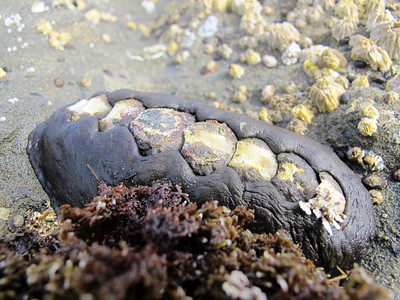
Like many snails and some other mollusks, black leather chitons lick algae off the rocks with tongues that are studded with metal-tipped points. Over time, legions of chitons can literally wear down the rock. Black leather chitons live in places with heavy surf: How do they stay attached to the rock when big waves crash?
The underside of the chiton has a deep slit a little inside the outer edge, where the gills are located, with a muscular foot in the center. The middle of this foot is pulled up while the outside edges seal, creating a suction that clamps the animal down. They move by relaxing the suction and making undulating waves against the rock with the foot. The black leather chiton’s low profile and slick surface probably also help resist the water’s pull.
Black leather chitons on the move are sometimes pried off the rock by black oystercatchers and eaten. People prying chitons off the rock can hurt them enough to kill them.
 |
How do grazing molluscs feed?
Molluscs that graze to feed, such as most snails and chitons, scrape their food using paired, strap-shaped tongues that together are called the radula. Each strap is armed with many sharp, hard-tipped teeth; the pair of straps can look rather like an unzipped metal zipper.